Saturday, April 14, 2012

Oh the Burnsiness of it all!

Last week, Rachel and I visited Alloway. This wee town is the birthplace of the Poet Burns. You must allow me to digress and quote one of my favourite exchanges from the Jeeves & Wooster series:
Bertie: The rank is but the penny stamp.
Jeeves: The guinea stamp, sir. The Poet Burns was writing at a time when--"
Bertie: Never mind the Poet Burns, Jeeves.
Jeeves: No, sir.
Bertie: Expunge the Poet Burns from your mind.
Jeeves: I have already done so, sir.
Bertie: What about the Aunt Agatha? She will kick, Jeeves.

Thank you. In any case, Rachel and I certainly did not expunge the Poet Burns from our minds! We recalled many of his songs, and quoted snatches of his poems (well, Rachel did, in any case, for which I was most grateful!).

A lovely fox statue!


These lovely weathercocks were all depicting scenes from "Tam o' Shanter" ( a poem which seems to have some similarities to the "Legend of Sleepy Hollow") 


The devil playing bagpipes, witches and graves! Smashing!


'Wee, sleekit, cow'rin, tim'rous beastie...'

Only this particular mouse is not so wee!

The new, fancy museum was fabulous in that *all* their information panels were in modern Scots (with some words explained in English below). WHAT a fabulous idea!

Look at this hare! Unfortunately I didn't get all of his huge, fluffy feet in my picture.

A carved scene from "Tam o' Shanter"


This is the image (repeated oft in sculpture and painting) that put me so strongly in mind of "Sleepy Hollow.

Thursday, April 12, 2012

Govan Churchyard

Not only were there treasures inside the church (and all those had been outside until the 1950s) but there were also wonderful graves out in the churchyard.

a grave from 1805

A LOT of the stones in this graveyard said, "This is the place intended for..." I kept thinking of Brigham Young: "This is the Place!" Hah!


"This is the place" again!


Wednesday, April 11, 2012

Govan Old Parish Church

Govan is not far away, but I had never been there until I went the day before Easter. I thought it would be a nice Eastery sort of thing to do, to visit an old church, and learn of it's ancient history.

The current building is not that old (1880s). But it was built on a site that has seen either 4 to 6 other churches (it is a matter of some dispute) since the 6th century. What makes this spot in Govan so unique is that it is home to a large collection of early Christian cross-slabs and hogback tombs (a Viking-style tombstone). It is quite unusual for such a concentration of them to be found in one place. The cross slabs and tombs date from the 9th to 11th centuries.
Just outside the church. You know how WW1 memorials always catch my eye!


The Church

One of the cross slabs. The initials were added later - 17th century.


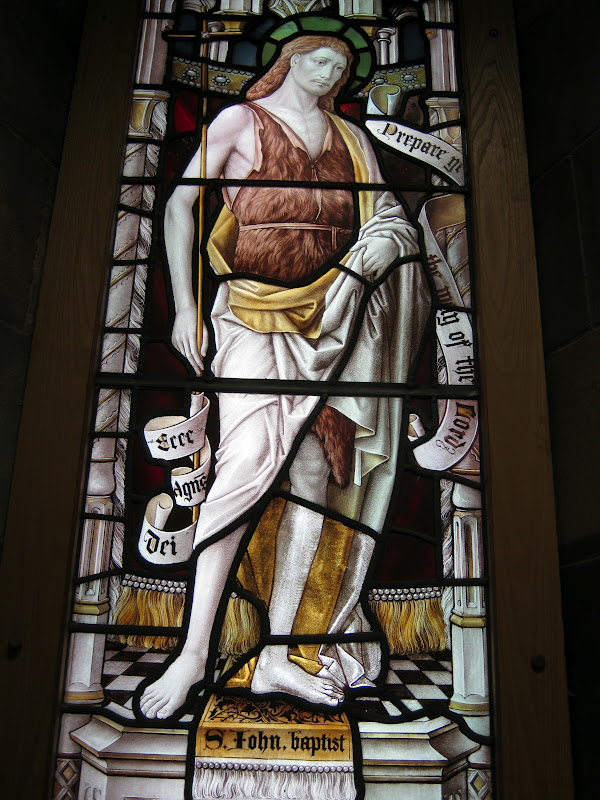
I forgot to mention that the church is full of beautiful stained glass. These were installed in 1891, and they were all ordered by the minister at the time. On one side of the church they are Old Testament, on the other they are New Testament.


And now, back to the cross-slabs. My guide told me that this is indicative of the Govan style, with the 'intestinal'  carvings, and the edge that looks like a pie crust. 

A panel on the 'sarcophagus'
And another panel.

A close-up of the snake panel. According to my guide, snakes weren't always the baddies they've become, but were once a symbol of re-birth.

There's a fine figure of a man on his horse. I think! 

The hogback tombstones.


A very unusual stone, called the 'Sun stone'. Again, we see the snakes coming out of the boss in the middle (at least, I think they're snakes!) 

All hogback tombs have an animal at the end - usually a bear. This one is unusual, in that it has two animals with their legs crossing, and their mouths together. My guide didn't tell me what animals they are, though. I think they look like sheep!


Tuesday, April 10, 2012

Spring moments in Glasgow

These are various places around Glasgow.
Hey! It's Beethoven (on Renfrew Street)!

A wee chuckle for my younger days.

Old shops (also on Renfrew Street)


Spring blossoms (with a wee spring dolly in the branches - Hungarian or some such!)

I love this library poster in the subway.

Passover

Once again, I've become a little behind in my posts. At Family Home Evening, we decided to have a Passover meal. We did this last year, pretty successfully. This year I had the Passover Haggadah from the Masons, with which I am much more comfortable. Also, we decided to invite a family to celebrate with us. We decided that Patsy and her children would be the perfect family to invite.

Scott (Patsy's husband) is the one sitting to the far left.  Phillipa and Miranda going around and washing everyones hands (with Bro & Sis Hicks)


The Elders, Trisha, Simon and Tony. The fellow with his back to us is Vikas, an investigator. 

This wasn't a completely proper passover: ie we used a chicken instead of a lamb.

Rachel & myself at the Passover meal.

Saturday, April 7, 2012

Easter: Resurrection and literary references to the Bible

Well, I haven't been very jazzed up about Easter this year, which is a shame, really. This morning I felt as though maybe I'd been a little flippant about it, which I hadn't intended at all. So I sat down with the gospels and read through the end of Jesus' life. My favourite account of Christ's resurrection is the version in John, for two  reasons. First, when Mary sees Jesus, she takes him for a gardener. I like this little mention. When I visited Glamis Castle several years ago, there was a painting in the chapel of Mary and Jesus - with Jesus dressed as a gardener (with a flat, wide-brimmed hat on). I couldn't find the exact painting online, more's the pity, but I did find other similar ones.

Lavinia Fontana, 1581

This one was not at all like the one I saw, but I quite like it, I suppose for the incongruous, sumptuous Medieval feel to it. He isn't wearing a hat, but he does have a trowel. (Christus als gaer, 1507. Jacob Corn. van Oostsanen)
The other reason that I like the John version the best is because of what Jesus says to Mary when she does finally recognise him. He says, "touch me not" - and the footnote (Joseph Smith Translation) expands this into "hold me not" which is far more tender and intimate (whether you're one of those who believes Jesus was married or not). That is why I am usually disappointed with Mary-at-the-tomb paintings, as they're very stiff and not very dynamic. This is one that I like, for the colours, and the poses of Jesus and Mary, and I like the glowing angels in the tomb as well.

Noli Me Tangere, 1524. Holbein the younger.
Also, while I was reading John, what Mary says to the angels reminded me of a poem I've read. She says, "They have taken away my Lord, and I know not where they have laid him."

There is a Kipling poem called "A Nativity 1914-18" and which one cannot help but parallel with the experience he and his wife suffered when their son went missing in the War. In fact, he directly quotes this line in his poem, as well as echoing it throughout:


The Babe was laid in the Manger
  Between the gentle kine --
All safe from cold and danger --
  "But it was not so with mine,
                  (With mine!  With mine!)
  "Is it well with the child, is it well?"
    The waiting mother prayed.
  "For I know not how he fell,
    And I know not where he is laid."
A Star stood forth in Heaven;
  The Watchers ran to see
The Sign of the Promise given --
  "But there comes no sign to me.
                   (To me! To me!)
  "My child died in the dark.
    Is it well with the child, is it well?
  There was none to tend him or mark,
    And I know not how he fell."
The Cross was raised on high;
  The Mother grieved beside --
"But the Mother saw Him die
  And took Him when He died.
                   (He died! He died!)
  "Seemly and undefiled
    His burial-place was made --
  Is it well, is it well with the child?
    For I know not where he is laid."
On the dawning of Easter Day
  Comes Mary Magdalene;
But the Stone was rolled away,
  And the Body was not within --
                   (Within! Within!)
  "Ah, who will answer my word?
    The broken mother prayed.
  "They have taken away my Lord,
    And I know not where He is laid."
      .    .    .    .    .

"The Star stands forth in Heaven.
  The watchers watch in vain
For Sign of the Promise given
  Of peace on Earth again --
                   (Again! Again!)
  "But I know for Whom he fell" --
    The steadfast mother smiled,
  "Is it well with the child -- is it well?
    It is well -- it is well with the child!"

And then, of course, if one is thinking of 1st World War biblical/poetical comparisons, one thinks of Wilfred Owen's 'Parable of the old man and the young" which is taken from the story of Abraham and Isaac:
So Abram rose, and clave the wood, and went,
And took the fire with him, and a knife.
And as they sojourned both of them together,
Isaac the first-born spake and said, My Father,
Behold the preparations, fire and iron,
But where the lamb for this burnt-offering?
Then Abram bound the youth with belts and straps,
And builded parapets and trenches there,
And stretchèd forth the knife to slay his son.
When lo! an Angel called him out of heaven,
Saying, Lay not thy hand upon the lad,
Neither do anything to him, thy son.
Behold! Caught in a thicket by its horns,
A Ram. Offer the Ram of Pride instead.

But the old man would not so, but slew his son,
And half the seed of Europe, one by one.

Well, on that happy note...I suppose it helps one remember why Easter and the resurrection are so important, and why we so desperately need the beauty and completeness of the atonement. 

Happy Easter, everyone!